Written by: Leyton Furlong
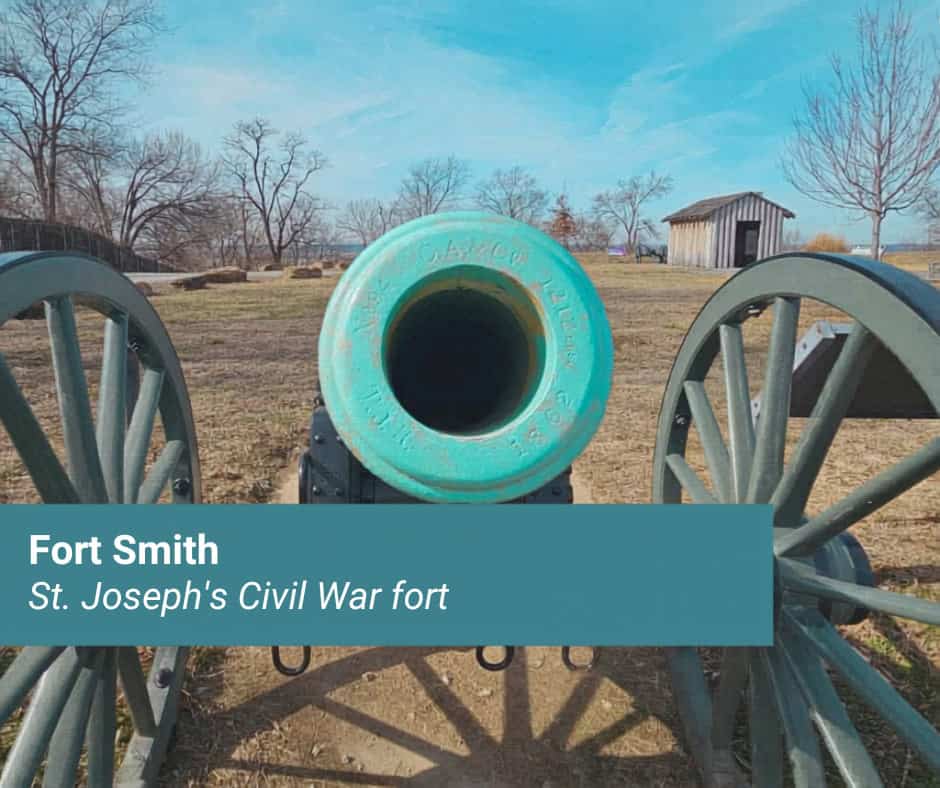
Perched on top of Prospect Hill, overlooking bustling downtown St. Joseph and the Missouri River, you’ll find a series of earthworks lined with cannons and wooden structures. During the Civil War, this was the site of an earthen fort built to protect the city from any Confederate forces that may come up or down river or approach the city from the east.
Why St. Joseph mattered in 1861
In 1861, the nation was embroiled in the Civil War. As a border state, Missouri’s loyalties were divided. At the start of the war, the population of St. Joseph was split in its loyalties. Due to St. Joseph’s strategic position on the Missouri River, the Federal government needed to retain control of the city. By late summer of 1861, the pressure to secure the city only grew as Rebel forces made attempts to occupy the city, and guerrillas sabotaged a railroad bridge crossing the Platte River near St. Joseph which derailed a civilian train, killing 17 and wounding many others.
Building Fort Smith on Prospect Hill
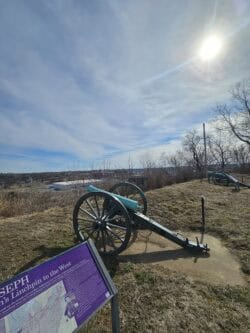
From September to October of 1861, about 3,000 Union reinforcements arrived in St. Joseph to enforce martial law. The largest of these detachments was the 16th Illinois Infantry under the command of Col. Robert F. Smith. Col. Smith’s men wasted no time in setting up camp. Using prisoners of war, and rebel sympathizers, Fort Smith was completed by November of 1861. The Fort’s walls were constructed from dirt and rock with a series of cannons operated by Battery B of the 2nd Illinois Artillery Regiment.
When practice shots went wrong
While the fort was designed to protect the city, the soldiers’ actions often had consequences for the civilian population. In December 1861, the people on 3rd Street heard a loud whizzing noise overhead. A few minutes later, there was another whizzing noise and a crash. They discovered it to be projectiles being fired from the Cannon on Prospect Hill towards a target on the side of France Hill, 2 miles away in a direct line over the city. The first cannonball went slightly more than ½ way to the target before burying itself under the platform of the Hannibal and St. Joseph Railroad passenger depot. The second shot again went ½ way to the target, tore through the cupola of a livery stable on 4th Street (owned by Frank West), crashed through a bowling alley, hit the street outside, bounced 100 feet, and hit a fence post before burying itself under an outhouse.
Low morale and a short lifespan
Although nearly all of the units stationed there were transferred elsewhere and the fort was allegedly condemned in February of 1862, Battery B of the 2nd Illinois Artillery remained at the fort until April. In that time, another accident occurred on February 22nd during a President’s Day celebration. While loading one of the cannons to fire off a ceremonial salute, one of the cannons prematurely detonated and severely injured one of the artillerymen.
Rediscovery and the park today
The fort remained in use until mid-1862, with other units and local militias guarded St. Joseph while living in barracks in the city. Fort Smith was noted in an 1868 illustration of St. Joseph. The earthworks were recorded as being visible in the 1898 and 1904 Buchanan County histories

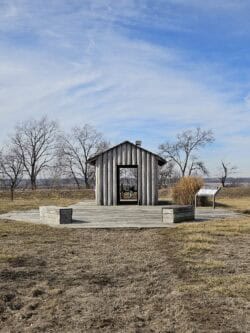
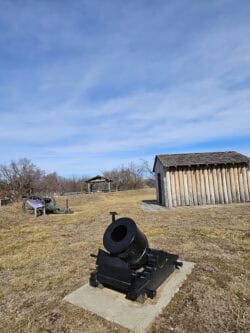
In 2010, as part of the 150th Commemoration of the Civil War, the history of the fort came to the forefront. During an archaeological dig, evidence of the earthworks as well as other Civil War era items were found on Prospect Hill. The City acquired the land, and the re-constructed Fort Smith was opened in 2013. The park today features many replica cannons and interpretive signage. Also on site is a wooden building which displays blueprints for cannons and other images, as well as shelters and benches for viewing Downtown St. Joseph.
FOR MORE INFORMATION
Fort Smith Park
802 Prospect Avenue, St. Joseph, MO 64501
Fort Smith Park is typically open seasonally (often listed as April 16 to October 14) and includes interpretive features like three full-scale reproduction cannons and restored redoubts.