Things to do

Museums & Historic Sites

History comes alive throughout the city of St. Joe. Once a thriving trade stop and the starting point of the Pony Express, the town has held firm to its roots. Fascinating historical sites and museums commemorate the generations of folks who have made the area their home. It’s hard to even go a few feet in the city without coming across a historical marker that recounts an extraordinary story. Read more about our history:

Fun for the Family

With 13 museums and many more sites listed on the National Register of Historic Places, St. Joseph is a “historical experience” unlike any other. As the original place “where the west officially started getting wild”, St. Jo paved the way for the development of the western half of the country. Learn about our role in westward expansion through the many interactive exhibits on display.

Interesting Facts About St. Joseph

St. joseph has had a number of distinctions during its early history:

Until after the Civil War, St. Joseph was the westernmost point accessible by rail.

By 1900, St. Joseph was receiving over 70 passenger trains a day.

The Pony Express began here April 3, 1860.

The notorious Jesse James was assassinated April 3, 1882 by Robert Ford after setting up residence to plan more bank holdups.

In 1887, St. Joseph became the second city in the U.S. to have electric streetcars.

St. Joseph at one time ranked fourth in the nation for dry goods sales and fifth in hardware.

St. Joseph had its first telephone exchange in 1879.

Livestock has been a major part of St. Joseph’s economy since 1846.

St. Joseph was the 2nd largest city in Missouri during the Civil War.

Historic Architecture

Saint Joseph, Missouri is one of America’s best-kept secrets for historic architecture. Founded in 1843, St. Joseph quickly grew to become one of the most important sites of commerce and trade for the western continent. Early on it was at the forefront of advances in transportation and communication. Vast wealth generated by St. Joseph’s manufacturing and wholesale trade is reflected in our city’s extraordinary architecture. Architects working here in the 19th century studied at the finest schools in Europe and America, such Paris’ Ecole des Beaux-Arts. Their works in St. Joseph reflect the heights of fashion and design of the 19th and early 20th centuries. St. Joseph’s early progressive attitude toward public improvements also shaped our community. We were among the earliest American cities to have electric telephone service, and electric streetcar system, and a municipal airport. For a few years, St. Joseph even had more miles of electric streetcar lines than New York City. The city also built an extensive network of parkways and boulevards beginning in 1912 under the vision of famed landscape architect George Kessler.

Museum & Historic Site Directory

Agency Ford Museum
11351 State Rte FF SE, Agency, MO 64401
(816) 390-2023
WEBSITE

This museum, in a former school reflects the rural classroom experience. The museum also documents the history of Agency from the 1836 Platte Purchase to the present. After the Platte Purchase, Agency Ford was a thriving community, but, slowly, flooding caused the town to nearly vanish.

The museum is located in the Agency Community Center and is open by appointment and during all Agency community events.

Albrecht-Kemper Museum of Art
2818 Frederick Ave
(816) 233-7003
WEBSITE MORE INFO

As a nationally-recognized advocate for American art and culture, the Albrecht-Kemper Museum of Art serves as a cultural arts center for Northwest Missouri.

The AKMA serves as the only nationally-accredited museum dedicated to arts education and promoting emerging artists in the four-state region (northwest Missouri, northeast Kansas, southeast Nebraska, and southwest Iowa). Visitors in 2021 were from 11 states and multiple countries, and members live in 13 states across the nation.

The Albrecht-Kemper is known in the region as a community-centered organization promoting the visual arts. Communities served vary in age from education programs starting at six years old; exhibitions for high school students; outreach partnerships, research, and exhibition opportunities for undergraduate university students; events and education for working professionals; and programs specifically designed for seniors and retirees. The AKMA is situated in St. Joseph, Missouri in Buchanan County and serves primarily rural audiences.

Hours
10:00 am – 4:00 pm, Tuesday – Friday and 1:00 – 4:00 pm, Saturday, and Sunday.

Closed Mondays and Major Holidays

Admission
Adults $10.00, seniors $8.00, students $7.00, under 6 and members are free.

The museum is located in the Agency Community Center and is open by appointment and during all Agency community events.

Black Archives Museum
3406 Frederick Ave
WEBSITE

The Black Archives Museum honors the struggles and triumphs of St. Joseph and Buchanan County African Americans. Exhibits explore such topics as Slavery in Missouri, Before We Were Soldiers 1840s-1850s, Colored Soldiers in the Civil War, and the local impact of the national Civil Rights era. The Museum also includes the Black Archives Museum Hall of Fame, which showcases the achievements and contributions of St. Joseph’s Black community members in a wide variety of areas. Open 10AM – 5PM Monday – Sunday. Closed on major holidays. Check the website for pricing. Admission includes the Glore Psychiatric Museum and the St. Joseph Museum.

The museum is located in the Agency Community Center and is open by appointment and during all Agency community events.

Buchanan County Courthouse
411 Jules Street
WEBSITE

The Buchanan County Courthouse is a rare example of courthouse design from the late 1800’s period of architectural history and is listed on the National Register of Historic Places. It was here that the Ford brothers were tried for the murder of Jesse James. Open during regular business hours.

The museum is located in the Agency Community Center and is open by appointment and during all Agency community events.

Fort Smith Park
802 Prospect Ave
(816) 271-5500
WEBSITE

Fort Smith, named after Colonel Robert F. Smith, was erected in late September 1861 as a safeguard against conflicting armies battling on either side of the state line. With the strong possibility of battles reaching St. Joseph, Colonel Smith stood ready with his 2,500 troops and 12 cannon poised atop the newly created fortification on Prospect Hill. However the conflict was averted and by the spring of 1862, the Union troops at Fort Smith were downsized.

The fort was re-discovered in 2003. Amenities at Fort Smith Park include 3 full-scale authentic reproduction cannons, restored redoubts, a lookout point, period flags, informative signage, and an ordnance shed displaying illustrations of various types of artillery shells used in the conflict. The fort is a passive park, where visitors can come, relax, picnic and see a wonderful view of the city and beyond.

Fort Smith is open 9am – 5pm, 7 days a week, April 16th – October 14th. Closed October 15-April 15th.

Directions:

  1. I-229 to Highland Exit (Exit 7) (north and southbound I-229)

Highland to Dewey, Right on Dewey, Dewey to Poulin, Right on Poulin, Poulin to Bellevue, Left on Bellevue, Continue on Bellevue to Parking Area at Fort Smith (Bellevue curves to the left and becomes Michel).

  1. I-229 to St. Joseph Avenue Exit (northbound I-229 only)

St. Joseph Avenue to Main, Left on Main, Main to Poulin, Left on Poulin, Poulin to Bellevue, Left on Bellevue, Continue on Bellevue to Parking Area at Fort Smith (Bellevue curves to

the left and becomes Michel).

  1. I-29 to Frederick Avenue Exit (Exit 47) (north and southbound I-29)

Frederick going West to Francis, Right on Francis, Francis to Main, Right on Main, Main to Poulin, Left on Poulin, Poulin to Bellevue, Left on Bellevue, Continue on Bellevue to Parking Area at Fort Smith (Bellevue curves to the left and becomes Michel).

GPS location: Lat 39.772934, Long -94.863282


Among the many local donors that have made this project a success, additional funding was secured through two grants one through the sponsorship of the St. Joseph Chapter/Daughters of the American Revolution, National Society Daughters of the American Revolution and the second through a Missouri Humanities Council (MHC) grant, the only state-wide agency in Missouri devoted exclusively to humanities education for citizens of all ages. MHC has served as a state affiliate of the National Endowment for the Humanities since 1971.

The museum is located in the Agency Community Center and is open by appointment and during all Agency community events.

Glore Psychiatric Museum
3406 Frederick Ave
(816) 232-8471

Voted one of the top 10 attractions in Missouri in the 2017 USA TODAY® Readers’ Choice travel contest, the Glore Psychiatric Museum takes visitors across the wide span of historical treatment of mental illness and social attitudes towards mental health. Exhibits illustrate the changing face of psychiatric treatment and present the history of “State Lunatic Asylum No. 2” hospital.

Hours: Daily from 10 a.m.-5 p.m.; Closed on major holidays.
Check the website for pricing. Admission includes the Black Archives Museum, and the Glore Psychiatric Museum.; includes the Black Archives Museum, and the St. Joseph Museum.

3406 Frederick Avenue
Saint Joseph, MO 64506

InspireU Children’s Discovery Center
521 Felix Street
(816) 271-4900
WEBSITE

InspireU Children’s Discovery Center opened in December 2024. This state-of-the-art facility is dedicated to fostering physical health, mental wellness and educational enrichment. This 50,000 square foot facility features over 20 core exhibits, a rooftop Exploratorium, interactive play areas, and educational spaces aimed at families with children ages birth to 10. Through hands-on exhibits that encourage creativity, imagination, and physical activity, children and their families learn essential principles of health, wellness, and community-building. Positioned within walking distance to shops, restaurants, and event spaces, inspireU enhances the economic landscape of downtown St. Joseph while attracting and retaining young families seeking quality education and recreation for their children.

The museum is located in the Agency Community Center and is open by appointment and during all Agency community events.

Jesse James Home Museum
1202 Penn Street
(816) 232-8206
WEBSITE

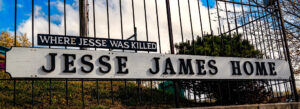
Located around the corner from the Patee House Museum on 12th Street, the Jesse James Home is the location at which infamous outlaw Jesse James was shot and killed on April 3, 1882.

At age 34, James had been an outlaw almost half his life. He was shot by a fellow gang member, Bob Ford, to collect a $10,000 reward. The bullet entered behind his right ear and — some believe — came out over his left eye, leaving the legendary bullet hole.

The museum features artifacts from Jesse’s life and death, as well as those of Frank James and the Ford brothers. Also in the museum is evidence from the 1995 exhumation, which proved with 99.7% certainty that the person killed in this house was, in fact, Jesse James.

Hours: Call first for updated hours.

Regular hours: Apr.-Oct. open Mon.-Sat. 9 a.m.- 4 p.m., and Sun. 12 p.m.- 4 p.m.; Nov.- March,

$4 adults; $3 seniors (60+); $2 students (17 and under); kids 5 & under free.

1202 Penn St
Saint Joseph, MO 64503
P: 816-232-8206

The museum is located in the Agency Community Center and is open by appointment and during all Agency community events.

Mount Mora Cemetery
824 Mount Mora
(816) 232-8471
WEBSITE

Mount Mora Cemetery, established in 1851, is the oldest operating cemetery in Saint Joseph, Missouri. It is listed in the National Register of Historic Places and is an interpretive site of The St. Joseph Museums, Inc.

Mount Mora was once the most fashionable burial place for many of St. Joseph’s wealthy and powerful citizens. The boom years of the post Civil War period, known as St. Joseph’s “Golden Age,” gave rise to the building of some of the finest residential architecture in the Midwest, and to some of the finest tomb architecture as well.

Established in 1851, Mount Mora is St. Joseph’s oldest operating cemetery and the burial site of many prominent citizens. Three Missouri governors, three generals, two Pony Express riders, and an English Baronet are among those found.

View a wonderful documentary about the history of Mount Mora, produced by Scout Productions.

Northwest Missouri Genealogical Society Library
412 Felix Street
(816) 233-0524
WEBSITE

The Northwest Missouri Genealogical Society and Library was formed in 1979 as a non-profit, educational organization. The library is a great resource to assist those doing family research.

They record and preserve genealogical records, assist in compilation of family histories, and further the interest in proper genealogical research methods. More specifically serving the counties of Andrew, Atchison, Buchanan, Clinton, DeKalb, Gentry, Holt, Nodaway, and Worth in Northwest Missouri.

Hours
Tuesday, 2:00 pm to 8:00 pm; Wednesday, 10:00 am to 3:00 pm; Thursday, 10:00 am to 3:00 pm; Friday, 10:00 am to 3:00 pm; Saturday (1st and 3rd of the month), noon to 4:00 pm.

During the months of inclement weather, you are encouraged to call ahead to verify the library will be open. Road conditions and illness may contribute to the library closing at unscheduled times.

If you are interested in visiting the library at another time, please send an email to the librarian and we will be happy to discuss other times which may be available to accommodate your schedule. PLEASE NOTE: The library is closed for the months of January and February. However, we are more than happy to assist researchers who may be visiting from out of town during these months. Please contact us to make arrangements.

Patee Park
900 Patee Street
(816) 271-5500
WEBSITE

Patee Park is located across the street from the Pony Express National Museum. A monument was placed in the park in 1913 by the Daughters of the American Revolution marking the starting point of the Pony Express on April 3, 1860.

In addition to this historic marker, visitors can find an antique locomotive engine, gazebo, a picnic shelter a fountain, and play equipment. It is also the home to the Pony Express PumpkinFest the 2nd weekend in October. A family arts & fall festival sponsored by the Pony Express Museum.

Pony Bar and Goetz Museum
1224 S 10th
(816) 279-5059
WEBSITE

The Pony Bar, formerly Bill’s Bar, has been restored to its 1923 glory.  The Pony Bar houses the Goetz Museum, exhibiting photos, artifacts, and stories of the Goetz family, Goetz Brewery, and the neighborhood formerly known as Patee Town, Goose Town, and Blue Town. Contact museum for special event venue information. $5 admission. See website for hours.

Pony Express Museum
914 Penn Street
(816) 279-5059
WEBSITE

Facebook.com/PonyExpressNationalMuseum

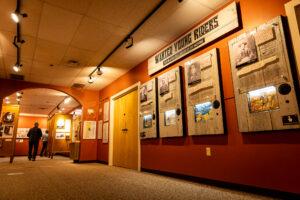
On April 3, 1860, at 7:15 pm, a lone rider left on horseback from the gates of one of the nation’s most historic landmarks, the Pikes Peak Stables in St. Joseph, Missouri. Carrying saddlebags filled with our nation’s hopes and dreams, the riders traveled 2000 miles west to Sacramento, California.

These brave young souls raced against nature’s cruel elements and rugged terrain in an attempt to unite a country separated by distance. Today the stables continue to stand as a tribute to the legend and legacy of the Pony Express and its enduring era. Come and experience the many exciting, educational, state-of-the-art exhibits conveying the need, creation, operation, and termination of the Pony Express. Whatever your age, you’re sure to be captivated by the stories and images of an era long passed.

Hours: Mon.-Sat., 9 a.m.-5 p.m.
Winter hours: Dec. 1 to March 1, 9 a.m.-4 p.m. Sun. hours 11 a.m.-4 p.m.
Pony School by appointment.

Admission:
Adult $10, Senior $9, Student (7-17) $5, Children (4-6) $3, 3 & under Free. Museum Members Free.
Special group prices.

Remington Nature Center
1502 McArthur Drive
(816) 271-5499
WEBSITE

The Remington Nature Center is where history and nature collide for a unique, fun, and educational experience. See a replica woolly mammoth, 8,000 gallon aquarium of Missouri fish, aviary, authentic American Indian artifacts, cultural and natural history displays, and
more.

Hours: Mon.-Sat. 10 a.m.-5 p.m., Sun. 1-5 p.m. Admission $4 for adults,

$3 for seniors 60+, $2 for youth ages 4-15, and free for children three and younger.

Robidoux Row Museum
3rd & Poulin
(816) 232-5861
WEBSITE

These circa 1840s housing units, built by city founder, Joseph Robidoux, met temporary housing needs of westward-bound pioneers. Includes restoration of Robidoux’s personal quarters and furnished with some belongings along with artifacts from St. Joseph’s past.

Tue.-Sat. 10 a.m.-4 p.m.

$4 adults; $2 seniors; $1 students 6-18; 5 and under Free.

Rental rooms available for parties and meetings.

St. Joe Harley-Davidson Museum
4020 S US Hwy 169
(816) 233-9061
WEBSITE

The museum explores the history of how St. Joe Harley-Davidson started. They opened the doors here in St. Joseph 50 years ago, and is still run by the same family!

Open Tues. – Fri. 9am-6pm & Sat. 9am-4pm.

St. Joseph Museum
3406 Frederick Ave
(816) 232-8471
WEBSITE

Visit the newly renovated St. Joseph Museums featuring the Archaeology and Native American Galleries.
A Cabinet of Curiosities

Start your exploration of the newest museum wing with a Cabinet of Curiosities, This unique exhibit explores the roots of modern museums starting back in the 16th century with curiosity shoppes, private collections and sideshows.  The collections were based on the original 4 societal trends: Naturalia, Artificialia, Exotica, and Scientifica. You will want to spend hours exploring the numerous drawers of this room housing everything from weaponry and medical devices to taxidermy and jewel encrusted insects.

Paleontology, Archaeology, World Cultures

As you make your way through the wing you will be taken back in time from dinosaurs to the prehistoric peoples in the St. Joseph area with fully interactive exhibits on Paleontology, Archaeology and World Cultures. Visitors will be able to explore the paleontology of ancient Missouri, examine gemstones, sift through the dirt of a archaeological dig, identify prehistoric beasts, reconstruct ancient pottery, and travel the world from the comfort of your local museum.  Featured exhibits include the King Hill Archaeological Dig, World Archaeology, Native American Pottery and more! Come explore ancient St. Joseph today!

Native American Basketry and Beading ​

Explore the culture of basket weaving and design with the extensive Grace Nicholson Basket Collection. Learn the differences of tack, line and loom stitching while enjoying amazing Native Beadwork in the beading room.

The Museum of Us

Do you ever wonder what Archaeologists 200 years from now will think of us? Explore the future of archaeology in The Museum of Us. From technology like movies and phones, to the tech boom of the 1980s, you’re sure to find something special in this new section. There’s even some PacMan and Super Nintendo in the Arcade room!

Hours: Daily from 10 a.m.-5 p.m.; Closed on major holidays.

Check the website for pricing. Admission includes the Black Archives Museum, and the Glore Psychiatric Museum.

Walter Cronkite Memorial
4525 Downs Drive
(816) 271-4100
WEBSITE

The Walter Cronkite Memorial, a tribute to the famed news anchor who was born in St. Joseph, is located in Spratt Hall Atrium at Missouri Western State University, 4525 Downs Drive. The Memorial includes several wall displays devoted to all aspects of his life, from his childhood and family to his time at the anchor desk and his passion for NASA’s Space Program.

The Walter Cronkite Memorial honors St. Joseph’s native son with interactive kiosks, photographs, video, a replica of Cronkite’s CBS newsroom, and a multimedia performance highlighting the legendary journalist’s broadcast career.

Admission to the Memorial is free.

Monday-Friday: 10 a.m. – 4 p.m.
Closed weekends

Closed Easter, Independence Day, and Missouri Western State University scheduled breaks

2020 Scheduled Breaks:

  • Martin Luther King, Jr. Day: 1/20/20
  • Spring Break: 3/8/20 – 3/15/20
  • Memorial Day: 5/25/20
  • Labor Day: 9/7/20
  • Fall Break: 11/22/20 – 11/29/20
  • Winter Break: 12/24/20 – 1/3/20

Please note that the Memorial will be closed whenever the University is closed for inclement weather.

Wyeth-Tootle Mansion
1100 Charles
(816) 232-8471
WEBSITE

Features hand painted ceilings, ornate woodwork, and stained glass windows.

Explore Confluence: The Great Flood of 1993 exhibit, which depicts the impact of flooding on the area. The history of local architecture is shared through the Intersection of Time and Buildings exhibit and the Architecture of Edmond Eckel exhibit. Doll Museum collection coming to Wyeth Tootle Mansion in 2019.

Check the website for pricing.

Historical Points of Interest

The Pony Express was founded by William H. Russell, William B. Waddell, and Alexander Majors. Plans for the Pony Express were spurred by the threat of the Civil War and the need for faster communication with the West. The Pony Express consisted of relays of men riding horses carrying saddlebags of mail across a 2000-mile trail.
Patee House National Landmark Museum

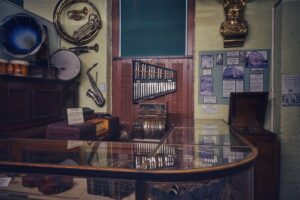
Built in 1858 as a luxury hotel, Patee House served as the Pony Express headquarters from 1860 to 1861. Patee House is St. Joseph’s only National Historic Landmark. Patee House Museum features two full floors of exhibits. Inside Patee House, you can climb aboard an 1860 train and ride the vintage “Wild Thing” carousel. (Photo by Patrick P. Evenson)

The service opened officially on April 3, 1860, when riders left simultaneously from St. Joseph, Missouri, and Sacramento, California. The first westbound trip was made in 9 days and 23 hours and the eastbound journey in 11 days and 12 hours. The pony riders Annual Pony Express Re-Ride covered 250 miles in a 24-hour day.
History Galore: Pony Express National Museum

Eventually, the Pony Express had more than 100 stations, 80 riders, and between 400 and 500 horses. The express route was extremely hazardous, but only one mail delivery was ever lost. The service lasted only 19 months until October 24, 1861, when the completion of the Pacific Telegraph line ended the need for its existence. Although California relied upon news from the Pony Express during the early days of the Civil War, the horse line was never a financial success, leading its founders to bankruptcy. However, the romantic drama surrounding the Pony Express has made it a part of the legend of the American West.

No event In American History has captured the imagination of young and old alike, more than the excitement created by those young riders and their horses, as they rode across the western half of our continent.

The documentary “1861: Spirit of the Pony Express” is now available on Amazon for $9.99

Centered around the history of the Pony Express itself, this documentary celebrates the institutions and personalities that keep that history alive today. The film is comprised largely of interviews of the people of St. Joseph, Missouri and others along the trail to California, who have dedicated their lives to teaching the history of that important time in the development of America.

The hope of this project is to communicate the importance of preserving our country’s historic trails – The National Park Service has acknowledged these efforts and opened up a a huge window of opportunity; helping filmmakers follow the National Pony Express Association’s cross country re-ride from Sacramento CA to St. Joseph MO in 2010 for the Sesquicentennial celebration of the historic institution.

Spending weeks on the original trail, the film crew stopped in various small towns along the way to find out what the history of the Pony Express means to the people there, and why they feel it is worth preserving. The goal of this documentary is to educate the world about the people and places that play an important part in shaping the history that surrounds us, and help inspire the generations to come.

Share this article

Of all the worlds’ legendary characters, few have attracted world-wide fascination like the outlaw Jesse James. Some call him America’s Robin Hood, while others see him as a cold-blooded killer. Perhaps he was all of these things.

Jesse Woodson James was born in Kearney, Missouri on September 5, 1847. His father, Rev. Robert James, was a Baptist minister who helped found William Jewell College in Liberty, Mo.

Some believe it was the harsh treatment by Union soldiers during the Civil War that pushed Jesse James and his older brother, Frank, toward a life of crime. During the war, both men rode with William Quantrill and “Bloody Bill” Anderson, where they learned the violence that would later define their lives.

After the war, Jesse was wounded while surrendering. It was his cousin, Zee, who nursed him back to health. Jesse married Zee after a nine-year courtship. She was named after his mother, Zerelda, and he called her Zee for short. They had two children, Jesse Edwards and Mary.

Within a year, Frank and Jesse are believed to have pulled off the first daylight bank-robbery in peace time. They made off with $60,000 from the Liberty, Mo. bank not far from their home, andone man was killed. For the next 15 years, the James brothers roamed across the United States, robbing trains and banks of their gold while building a legend that has endured for more than a century after Jesse’s death.

The Pinkerton Detective Agency was called in to help catch the famous desperadoes. Once during a nighttime raid on the family home outside Kearney, Mo., a firebomb was tossed into the log cabin. When it exploded, it tore off the hand of Jesse’s mother, and led to the death of hishalf-brother Archie. Jesse reached his Waterloo in September 1876, when his gang, including the Younger brothers, took on the bank at Northfield, Minnesota. Within minutes the town people returned fire. All except Frank and Jesse were either killed or were wounded and captured.

Frank James also married, and their wives tried to get them to take on a more normal life. With a $10,000 reward on his head, Jesse moved to St. Joseph, Mo., with his family in the fall of 1881 to hide out from the law.

After a brief stay in another house in St. Joseph, it was on Christmas Eve that Jesse and Zee moved their final family home atop a high hill overlooking St. Joseph. Living under the assumed name of Tom Howard, Jesse rented the house from a city councilman for $14 a month. He attended church but did not work for a living.

During the winter of 1882, Jesse tried to buy a small farm in Nebraska. But in April, he was short of cash. All of his earlier gang members were either dead or in prison, but Jesse recruited Bob and Charlie Ford to help him rob the Platte City bank. The Ford brothers posed as cousins of Jesse James, but actually were not related to Jesse at all.

The $10,000 reward on Jesse proved too appealing to the Brothers. While Jesse stood unarmed on a chair in the family home in St. Joseph to dust and straighten a picture, Bob and Charlie Ford drew their guns.

Bob Ford put an end to the James legend with a single bullet to the back of Jesse’s head on April 3, 1882. Jesse was 34 years old. After the shooting, Jesse’s wife and two children along with his mother, Mrs. Zerelda Samuel, spent the next two nights at Patee (Pay-Tee) House, which was then called the World’s Hotel. 

The hotel also became the center of investigation location due to its close proximity to the house, located at 1318 Lafayette Street. It is now an amazing historical museum giving a glimpse of St. Joseph and the 1850-1930 time period.

The Jesse James Museum is a non-profit museum, focused on the life, death and legacy of Jesse James. In 1995 forensic scientist James Starrs exhumed the outlaw’s body at Kearney, MO, for DNA tests. The results showed a 99.7% certainty that it was Jesse James who was killed in St. Joseph in 1882. Artifacts from the grave are now on display including the coffin handles; a small tie pin Jesse James was wearing the day he was killed; a bullet removed from his right lung area; and a casting of his skull, showing the bullet hole behind his right ear.

The James Home was originally located about two blocks north of its present location, on Lafayette Street, on a high hill overlooking Patee House. In 1939, it was moved to the Belt Highway in St. Joseph as a tourist attraction. Mr. and Mrs. Robert Keatley purchased the James Home in 1977 and donated it to the Pony Express Historical Association. The house was moved back to its original neighborhood and today it is located on the grounds of Patee House Museum.

The Jesse James Museum and Patee House Museum is operated by the Pony Express Historical Association with all proceeds from admission charges going to help maintain both the Patee House Museum and the Jesse James Home.

The Ford brothers attempted to collect the reward. Instead, they were charged with murder. They were sentenced to hang but were pardoned by Governor Tom Crittenden. The courtroom judges bench that the Ford Brothers stood before during their trial still remains in the Buchanan County Courthouse.

Two years after the assassination, Charles Ford committed suicide and Bob Ford, the “dirty little coward who shot Mr. Howard, and laid poor Jesse in his grave,” was himself killed in a bar room brawl in Creede, Colorado, in 1892. Jesse’s brother Frank James gave himself up a few months after the assassination. 

He was tried for murder in Missouri and found not guilty, tried for robbery in Alabama and found not guilty, and finally tried for armed robbery in Missouri and again released. A free man, he retired to a quiet life on his family’s farm, dying in 1915 in the room in which he was born.

Jesse James was a moral paradox. He was a good father and family man, and was religious in his own way. Whether he stole from the rich and gave to the poor, or just kept it all himself, has never been decided. 

Jesse James died in 1882, but the legend of Jesse James continues more than a century beyond his death. Today Jesse and Frank James are among the best-known Americans in the World. 

In 2007, Warner Bros produced “The Assassination of Jesse James by the Coward Robert Ford”, starring Brad Pitt as Jesse James and Casey Affleck as Robert Ford.

Share this article

St. Joseph is known for many things: Pony Express, Jesse James, Cherry Mash Candy, and more. However, most people don’t connect St. Joseph with the Civil War. While no major battles were fought here, the conflict was deeply felt. Neighbors turned against neighbors, business partnerships dissolved and families became divided. Approximately 2,000 men fought for the Union, while roughly the same number joined the Confederate cause.

Extraordinary events in the Freedom’s Frontier National Heritage Area (FFNHA) forever changed America. In the nineteenth century, the nation turned its eyes to the Missouri/Kansas border, where people with diverse definitions of freedom collided, inciting and fueling the Civil War. The impact of these events is forever woven into the nation’s fabric. Freedom’s Frontier provides new opportunities for visitors and residents to explore the evolving ideal and fundamental American value of FREEDOM.

Civil War History in St. Joseph, MO

The war was barely a month old when the United States flag was torn down from the roof of the post office and destroyed by a secessionist mob. Union troops arrived in St. Joseph to keep the town under federal control and protect the Hannibal and St. Joseph Railroad. It wasn’t long, however, before they were ordered elsewhere. City leaders attempted to keep St. Joseph neutral, but the city was considered too important a transportation hub and commercial center to be left alone for long.

Shortly after the Union troops left, Confederate militia marched into town and took control. St. Joseph was looted. It is estimated that 25 wagons of various items were loaded up and headed South.

When word of the trouble in St. Joseph reached the Union Army, additional federal troops were sent to the city, arriving in September 1861. By the end of that year, St. Joseph was placed under martial law. Over the next four years, citizens were required to carry passes to enter or leave the city.

Many Southern sympathizers in St. Joseph refused to sign a loyalty oath to the United States and, as a result, were assessed heavy fines or jailed.

By the end of the war, roughly 2,000 men from Buchanan County had joined the Union Army, with approximately the same number serving the Confederacy. It took several years for St. Joseph to recover from the Civil War, but during the following decade the city reestablished its reputation as a commercial center.

Business returned, and the city grew and thrived, becoming one of the busiest and wealthiest cities in Missouri during the late 19th and early 20th centuries. Buchanan County is one of 41 counties represented in the Freedom’s Frontier National Heritage Area. Today, St. Joseph is home to nine registered Freedom’s Frontier sites, each with historical significance related to the Civil War. These sites feature exhibits highlighting the struggles and successes of the St. Joseph area during that time.

Share this article

Saint Joseph, Missouri, is one of America’s best-kept secrets for historic architecture. Founded in 1843, the city quickly became a key hub for commerce and trade in the western United States. Advances in transportation and communication, including the Pony Express, the transcontinental telegraph, early railroads and the Missouri River Bridge, helped establish St. Joseph as a center of western trade.

During the Victorian Era, St. Joseph was a major manufacturing center and attracted labor from as far away as Eastern Europe. Products such as Aunt Jemima Pancake Mix, Premium Saltine Crackers, St. Joseph’s Aspirin, Big Chief Tablets, Cherry Mash Candy and Country Club Beer are just some of the products first produced in St. Joseph.

The vast wealth generated by St. Joseph’s manufacturing and wholesale trade is reflected in our city’s extraordinary architecture. Architects working here in the 19th century studied at the finest schools in Europe and America, such Paris’ Ecole des Beaux-Arts. Their works in St. Joseph reflect the heights of fashion and design of the 19th and early 20th centuries. 

St. Joseph’s early progressive attitude toward public improvements also shaped our community. We were among the earliest American cities to have electric telephone service, an electric streetcar system, and a municipal airport. For a few years, St. Joseph even had more miles of electric streetcar lines than New York City. 

Many of the historic neighborhoods in St. Joseph have worked hard together to preserve and maintain the beautiful properties, and each one has its own unique experience. Read about some of them below and then feel free to explore the majestic architecture that makes St. Joseph so remarkable.

The Historic St. Joseph Emporium has information about various ways that you can experience this historic city! One great way is to take a tour with someone who has deep roots here. 

Jerry is the expert guide for Museum Hill and Krug Park Place. Learn more about these neighborhoods and how to book a tour by visiting The Historic St. Joseph Emporium under the Market Square tab.

(Neighborhood maps can be found at StJoeMo.info under historic preservation.)

More ways to explore: Self-Guided Tours of St. Joseph

Harris-Kemper Neighborhood

Located in historic Mid-Town, this mixed residential and commercial district showcases a wide variety of architectural styles including Greek Revival, Italianate, Romanesque Revival, Queen Anne, Colonial Revival, Tudor Revival, and Craftsman. 

There are several fine examples of the work of E.J. Eckel in the district. Historic details abound; if you look closely, you’ll find original limestone and granite curbing, herringbone sidewalks, concrete street markers (installed ca.1920), iron fencing and substantial stone retaining walls. 

Many outbuildings survive today including carriage houses, garages and one summerhouse. Most of the historic structures were built between 1860 and 1940.

Museum Hill Neighborhood

The Museum Hill Neighborhood, located east of historic downtown, is a mixed residential and religious district that has at its heart some of the most fabulous mansions and churches in the city. There are many styles of architecture to be found in the district, but the most common is Victorian Style (Italianate, Second Empire, and Queen Anne). Its showpiece is the Wyeth-Tootle Mansion, (12th and Charles streets) which is part of St. Joseph Museums Inc. and is the only historic mansion and gardens in the city open to the public (mansion is open weekends April- Oct., and the gardens all year). 

Many of St. Joseph’s most prominent families were attracted to this area by the opportunity to build on the hill and take advantage of wonderful views.

Krug Park Place

Krug Park Place, located in the North End of St. Joseph, sits adjacent to the park that gives the neighborhood its name. Originally designed to be exclusive and somewhat difficult to reach, it was one of the city’s first planned subdivisions. The district features substantial houses on generous lots with beautiful landscaping.

Though small (containing only about 18 principal buildings), Krug Park Place is an ideal starting (or ending) point for exploring the city’s Parks and Parkways, including Ashland Avenue and Lovers Lane. This area was made famous by Eugene Field’s poem “Lovers Lane, Saint Jo”, commemorated by a marker at Northwest Parkway and Lovers Lane.

Today, the neighborhood remains one of St. Joseph’s most charming, with homes showcasing a variety of architectural styles, tree-lined streets, and some of the city’s most impressive landscaping.

Old Town North

The neighborhoods along the bluffs north of historic downtown St. Joseph are collectively known as Old Town North. The area includes three National Register districts (Cathedral Hill, Hall Street, and Robidoux Hill), our historic Mount Mora Cemetery, and the founder’s house, which is now a museum called Robidoux Row. 

Along the streets of Old Town North, you’ll find a diversity of architectural styles, ranging from extraordinary palatial gilded-age mansions, to stately single-family homes and duplexes, to the most modest workingman’s residences. This district is also home to the only documented slave quarters known to remain in St. Joseph.

Share this article

On May 14, 1804, Meriwether Lewis and William Clark embarked on a journey across the uncharted lands of the newly acquired Louisiana Purchase. On their return trip, they traversed the Missouri River, traveling through what is now St. Joseph.

A number of places in the St. Joseph area have been designated as National Park Service certified Lewis and Clark national Historic trail commemorative sites. Explore these sites and relive the excitement of their journey.

Share this article